A detailed summary ofMeditationsby Marcus Aurelius
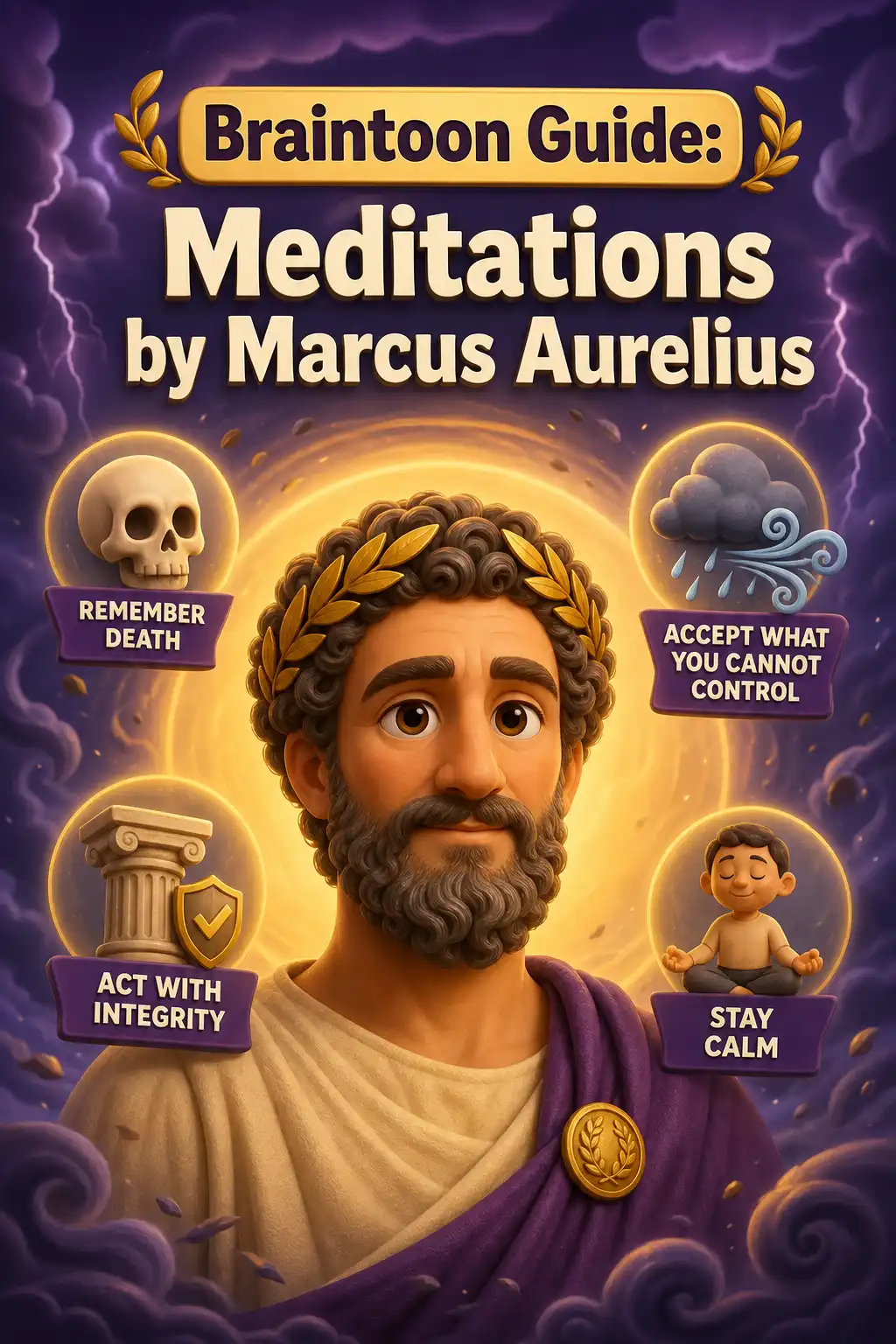
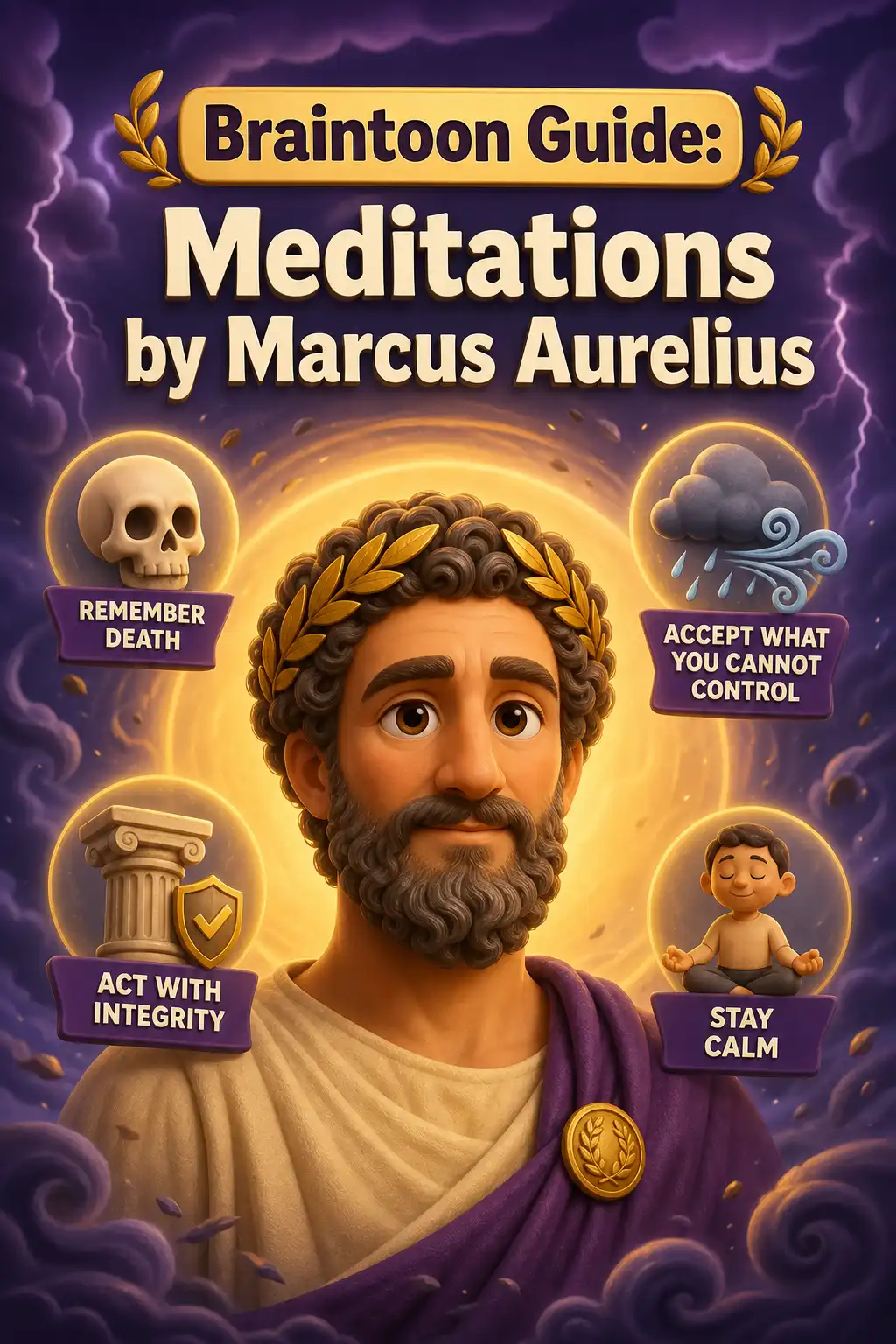
Meditations by Marcus Aurelius is the private journal of a Roman emperor, and it teaches you how to stay calm, act with integrity, and accept what you cannot control.








What if the most
0:00 / 1:00
60-second animated preview
Summary Visuals
Why You Suffer Twice
Turning Obstacles Into Fuel
A Stoic Day, Emperor Style
Meditations Summary
What if the most powerful man on Earth spent his nights writing secret notes to himself about how not to lose his mind, and what if those same notes could fix yours?
1. Your judgments hurt you, not events
Marcus Aurelius ruled Rome through a devastating plague, endless wars on the frontier, and even a betrayal by one of his own generals. His response? Writing private notes to himself, never meant for anyone else to read. Lucky for us, they survived.
The philosophy behind those notes is Stoicism, which teaches that the universe runs on reason, and a good life means lining your own mind up with that natural order.
Here is the first big move, what Stoics call the discipline of perception. A house burning down is just an event. Calling it a tragedy is a judgment you added on top, and you do not have to add it.
Marcus puts it bluntly. Choose not to feel harmed, and you have not been harmed. The damage was never really in the event itself. It was in your interpretation of it.
Meet Erin, an ER nurse in Denver. Twelve-hour shifts, short staffing, angry patients, and nights spent lying awake replaying every bad moment like a personal highlight reel of misery.
Erin's real problem is not the chaos. It is that every incident gets a label. Disaster. Insult. Proof the world is against her. She is suffering twice, once in reality and once in commentary.
Next step
Watch Meditations instead
Quick setup, then watch this summary in a more engaging visual format.
iOS + Android app20,000+ learnersFree daily summary
2. You were built for work, so get up
Marcus Aurelius, the most powerful man alive at the time, literally argued with himself every single morning about getting out of bed. If that is not relatable, I do not know what is.
His counterargument went like this. Bees, ants, and birds all get up and do their jobs without complaint. Are you really going to be out-hustled by an ant?
Humans, he says, are built for work and for helping each other. People who love what they do forget to eat and sleep. Service, in his view, deserves that same devotion.
This is not hustle culture. It is purpose. Staying curled under the blankets is not rest, it is refusing to be what you actually are. And remember, he said all this to himself first.
Erin's alarm goes off at five. The old routine was three snoozes and twenty minutes of dread. The new experiment is asking a single question. What was I actually made to do today?
The answer is annoyingly obvious. People will be scared and hurting today, and she can help them. That is not a burden. That is basically the job description of being a human.
3. Expect difficult people and skip the anger
Marcus started his day with a strange pep talk. Today I will meet meddling, ungrateful, dishonest people. This is not pessimism. It is preparation. You are never blindsided by what you already expected.
His explanation for bad behavior? People genuinely cannot tell good from evil. They are not villains, they are confused. And being angry at confusion is like being angry at fog.
He has a great image for this. Humans working against each other is as unnatural as your hands fighting your feet. We are parts of one body, whether we act like it or not.
And resenting someone for their flaws? That is like resenting a fig tree for producing sap. It is just what they do. Expecting otherwise was your mistake, not theirs.
One more trick. When someone infuriates you, ask when you have done the same thing yourself. Marcus admits he has made every mistake he sees in others. Anger softens fast after that.
Erin tests this when a patient's family member screams about wait times. Old Erin would seethe for hours. New Erin thinks, scared person, confused, doing what scared people do.
4. What stands in the way becomes the way
Here is the book's most famous idea. The impediment to action advances action. What stands in the way becomes the way. Obstacles are not blocking your path. They are the path.
Marcus compares a trained mind to a roaring fire. Throw an obstacle onto it and the fire does not get smothered. It consumes the obstacle and burns brighter.
He also compares painful events to a doctor's prescription. Unpleasant, sure, but ordered for a larger good. Complaining about your fate is like arguing with your treatment plan.
And here is the kicker. Misfortune only counts as misfortune if it corrupts your character. Endure difficulty with integrity, and Marcus says that is not bad luck. That is actually great luck.
The practical version is to strip every situation down. What is this, really? How long will it last? What does it demand from me? Usually patience or courage, not panic.
Erin gets passed over for the charge nurse role. Her first instinct is to spiral. Instead she asks the Stoic question. What does this obstacle actually make possible?
5. Your mind is the only retreat you need
Everyone fantasizes about escaping. The beach, the mountain cabin, the quiet countryside. Marcus calls this nonsense, and remember, this guy could actually afford all of those.
True peace, he says, is found by going inward. Your own soul is a retreat available at any moment, no booking required. A few minutes there restores real clarity.
Why does this matter so much? Because your soul takes on the color of your thoughts. Dwell on chaos, and you become chaotic. Dwell on what is good, and you become good.
He is ruthless about mental hygiene too. Stop obsessing over other people's motives and drama. Keep only the thoughts you would not be ashamed to say out loud.
Erin's old reset was doomscrolling in the break room, which is like treating dehydration with saltwater. Now she takes two minutes, closes her eyes, and just steps inside.
She asks what is actually in her control right now. Usually it is one patient, one task, one breath. The hallway noise does not stop. Her reaction to it does.
6. Strip things down and stop chasing applause
Marcus had a savage trick for killing desire. Describe things without the marketing. Roasted meat is a dead animal. Fine wine is fermented grape juice. Suddenly less impressive, right?
The same move works on status. Pride, he warns, is skilled at making trivial things seem important. Break any glamorous thing into its parts and the spell breaks with it.
As for fame, Alexander the Great and his mule driver ended up in exactly the same place. Even the most celebrated names fade like a guttering candle.
And beautiful things do not need applause. Truth and justice are not improved by praise. An emerald does not get greener when complimented. Chasing approval means renting your peace from strangers.
Marcus says approval-chasers are never free. They live in constant anxiety and jealousy. Then he suggests actually looking at the crowd you want admiration from. The craving dissolves fast.
Erin catches herself measuring her life against a nursing-school friend's Instagram. So she runs the exercise. It is a glowing screen showing curated pixels from a stranger's highlight reel.
7. Remember death, and it wakes you up
Marcus writes about death constantly, and not in a goth way. His point is this. You could leave life right now, so let that shape everything you do and say.
Time, he says, is a violent river carrying everything past. Entire cities have vanished. Emperors, philosophers, warriors, all dust now. This is meant to clarify, not depress.
Because here is the flip side. The present moment is the only thing anyone actually possesses. Lose it or keep it, and that is identical for everyone, however long they live.
Death itself? Just disembarking from a voyage. A knot being gently untied. Leaves blow away, new leaves grow. Nature transforms everything, and you were never an exception.
Erin sees death at work more than most, but she had built walls around it. Marcus offers something better than numbness. He lets mortality sharpen the value of right now.
After a hard loss on shift, she does not spiral into why-bother nihilism. She calls her mom, actually listens, and stops postponing her life until some imaginary calmer season.
8. Accept what happens and build your own luck
Final lesson, the one holding everything together. Marcus's rule for hardship. If it is endurable, endure it without complaint. If it is truly unendurable, it will end you, and the complaining stops anyway.
Grim humor aside, his real point is acceptance. Every event fits into fate's structure like blocks in a wall. Complaining is chipping away at the wall you are standing on.
This is not passivity. It is welcoming what happens while still acting justly, speaking honestly, and being useful. Accept the cards, then play them with everything you have got.
His definition of luck might be the book's best line. True good fortune is good character, good intentions, and good actions. Meaning you can manufacture your own.
Even on death, he stays consistent. An actor does not complain that the play ended too soon. The length was never yours to decide. Only the performance was.
Six months in, Erin's ER is still chaos. Same short staffing, same alarms. But she judges less, retreats inward more, and treats obstacles as raw material instead of verdicts.
Next step
Start watching in minutes
Take the short quiz and unlock animated summaries you can watch or listen to daily.
iOS + Android app20,000+ learnersFree daily summary
More books like Meditations

The Book of Five Rings
by Miyamoto Musashi
The Book of Five Rings, written around 1645 by Japanese swordsman Miyamoto Musashi, is a compact guide to strategy, training, and clear thinking under pressure.

The Untethered Soul
by Michael Singer
The Untethered Soul by Michael Singer teaches you how to step back from your thoughts and emotions, quiet the inner noise, and find real, lasting freedom inside yourself.

The Almanack of Naval Ravikant
by Eric Jorgenson
The Almanack of Naval Ravikant by Eric Jorgenson collects the best ideas of a legendary Silicon Valley investor into one practical guide for building wealth and happiness without sacrificing yourself.
The Subtle Art of Not Giving an F
by Mark Manson
The Subtle Art of Not Giving an F by Mark Manson is a blunt guide to living better by caring about less, choosing real values, and embracing life's struggles instead of running from them.

The Courage to be Disliked
by Ichiro Kishimi and Fumitake Koga
The Courage to be Disliked by Ichiro Kishimi and Fumitake Koga uses Alfred Adler's psychology to show how anyone can choose happiness, starting today.

Feel-Good Productivity
by Ali Abdaal
Feel-Good Productivity, by Ali Abdaal, shows you how to do more of what matters by using wellbeing as the engine, not raw willpower.
Related book lists
3 summaries
Stoicism
Find calm, resilience, and clarity through ancient wisdom.
15 summaries
Philosophy
Explore ideas about existence, ethics, and meaning.

12 summaries
Discipline
Follow through consistently, even when motivation dips.

12 summaries
Happiness
Boost well-being through mindset, habits, and emotional science.