A detailed summary ofNudgeby Richard H. Thaler and Cass R. Sunstein
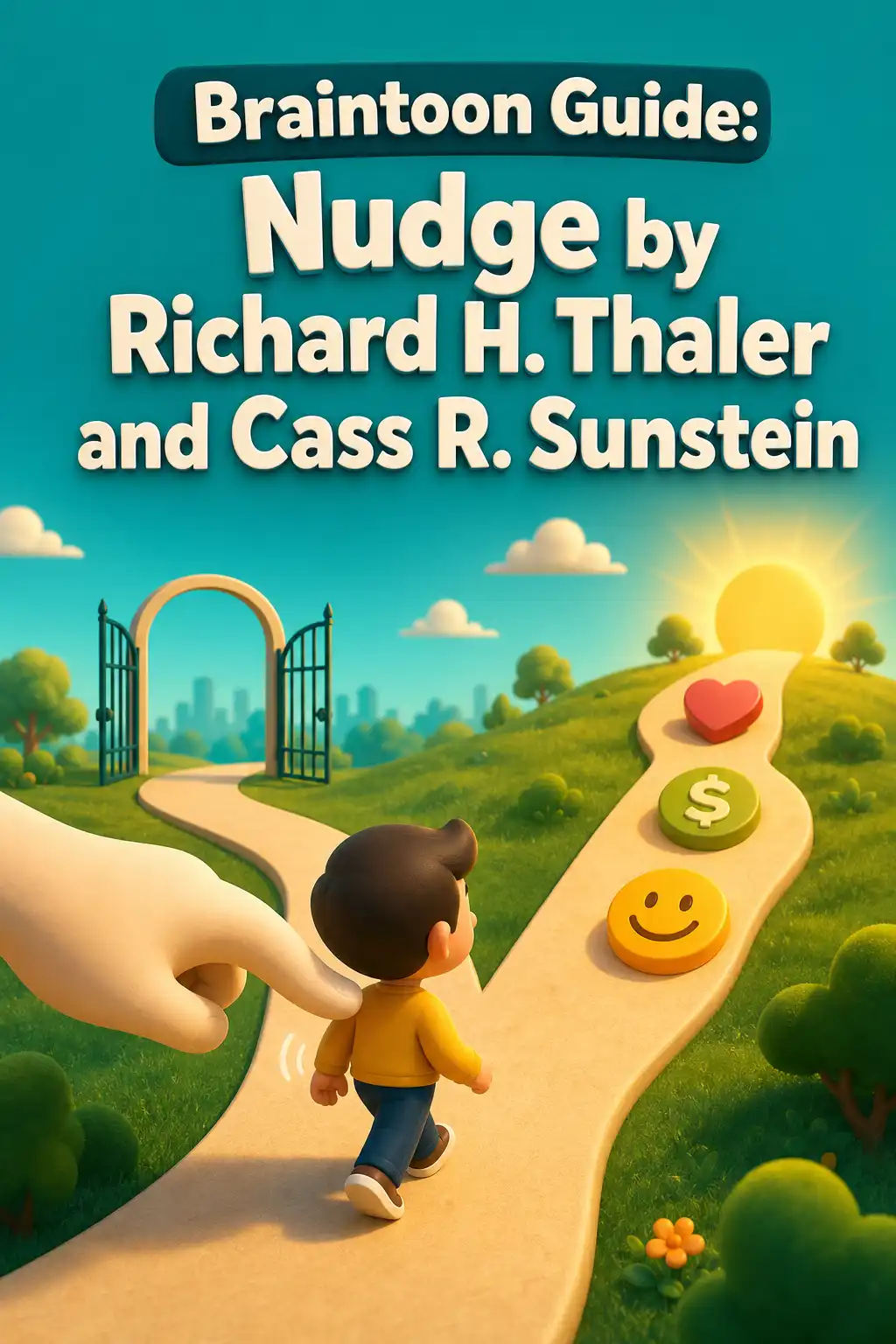
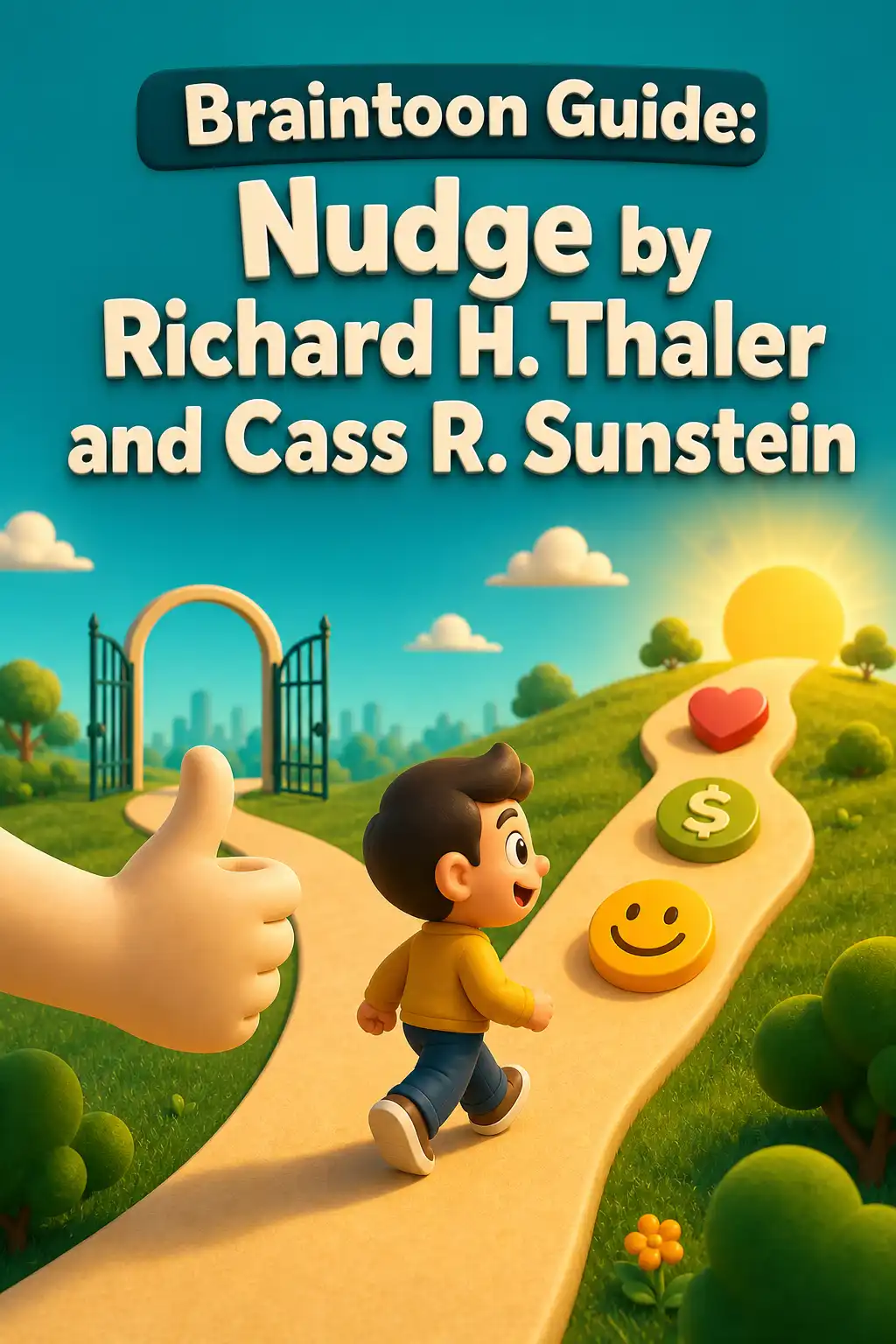
Nudge, by Nobel winner Richard Thaler and Harvard law professor Cass Sunstein, shows how small changes in how choices are presented can steer us toward better health, wealth, and happiness each day, while leaving us free to choose our own way.

What if your retirement account,
0:00 / 1:00
60-second animated preview
Summary Visuals
The NUDGES Design Checklist
Two Minds, Five Predictable Glitches
The Quiet Power of Defaults
Nudge Summary
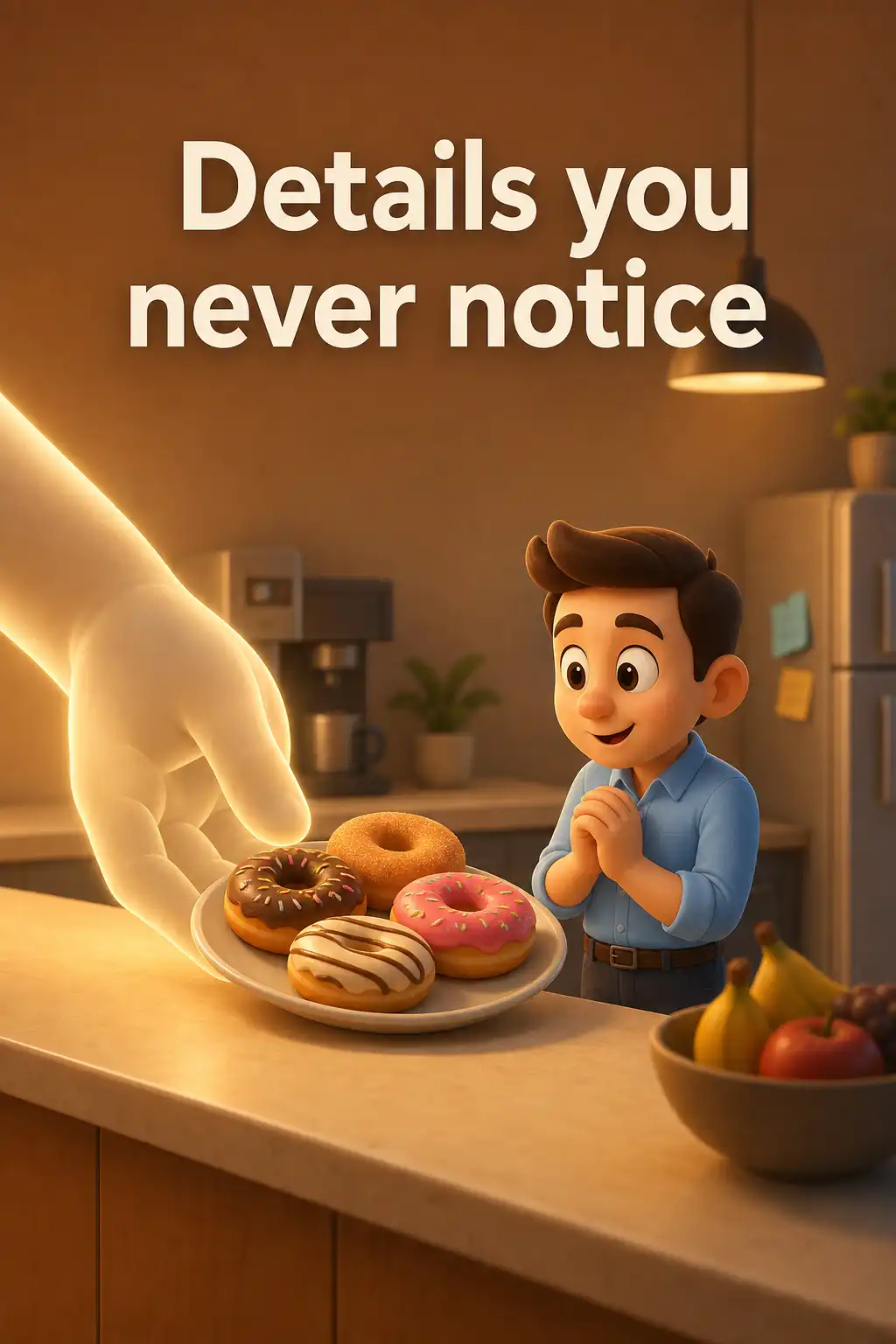
What if your retirement account, your health, and even your waistline were being quietly steered by details you barely notice, like which box comes pre-checked or where the snacks happen to be?
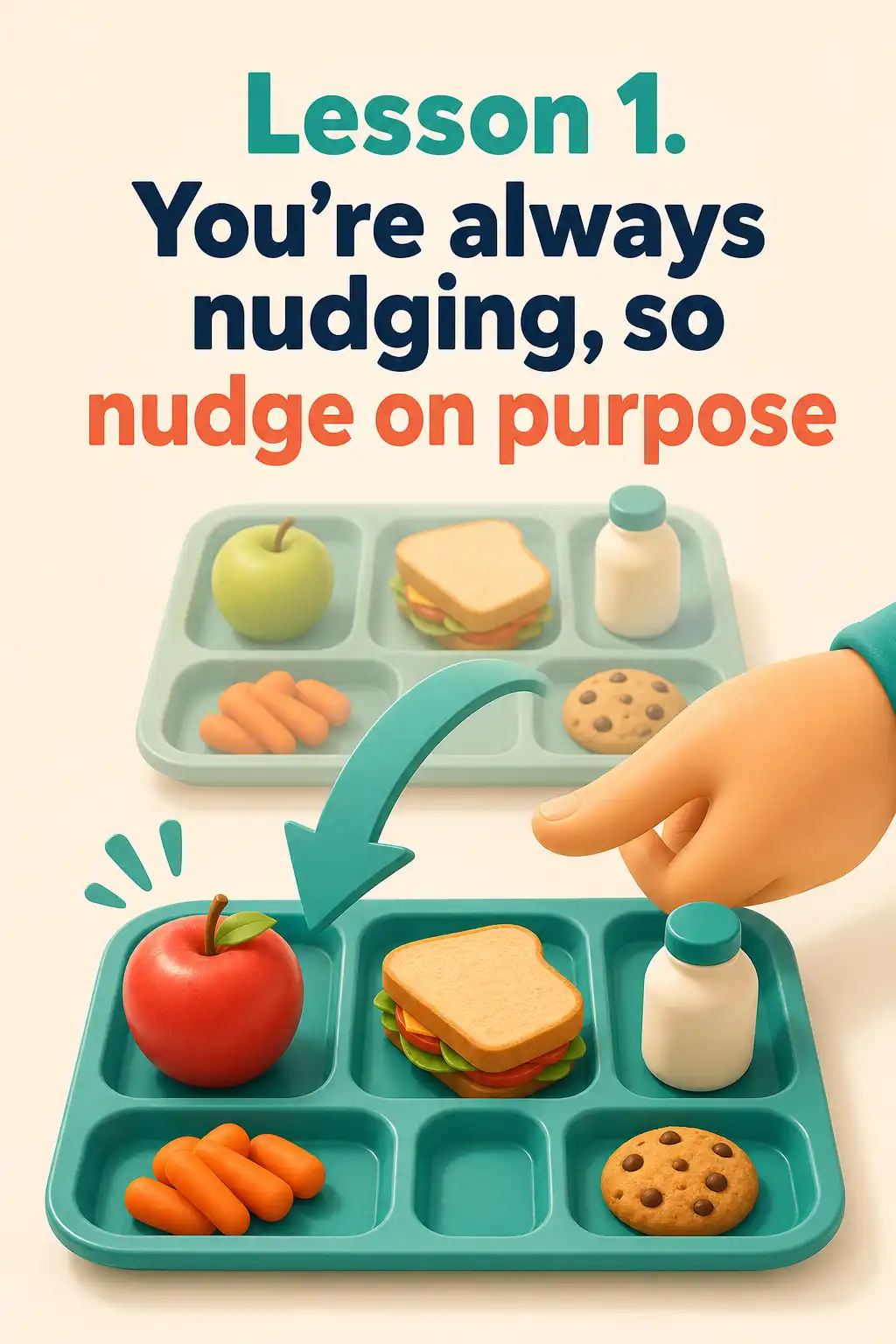
1. You're always nudging, so nudge on purpose
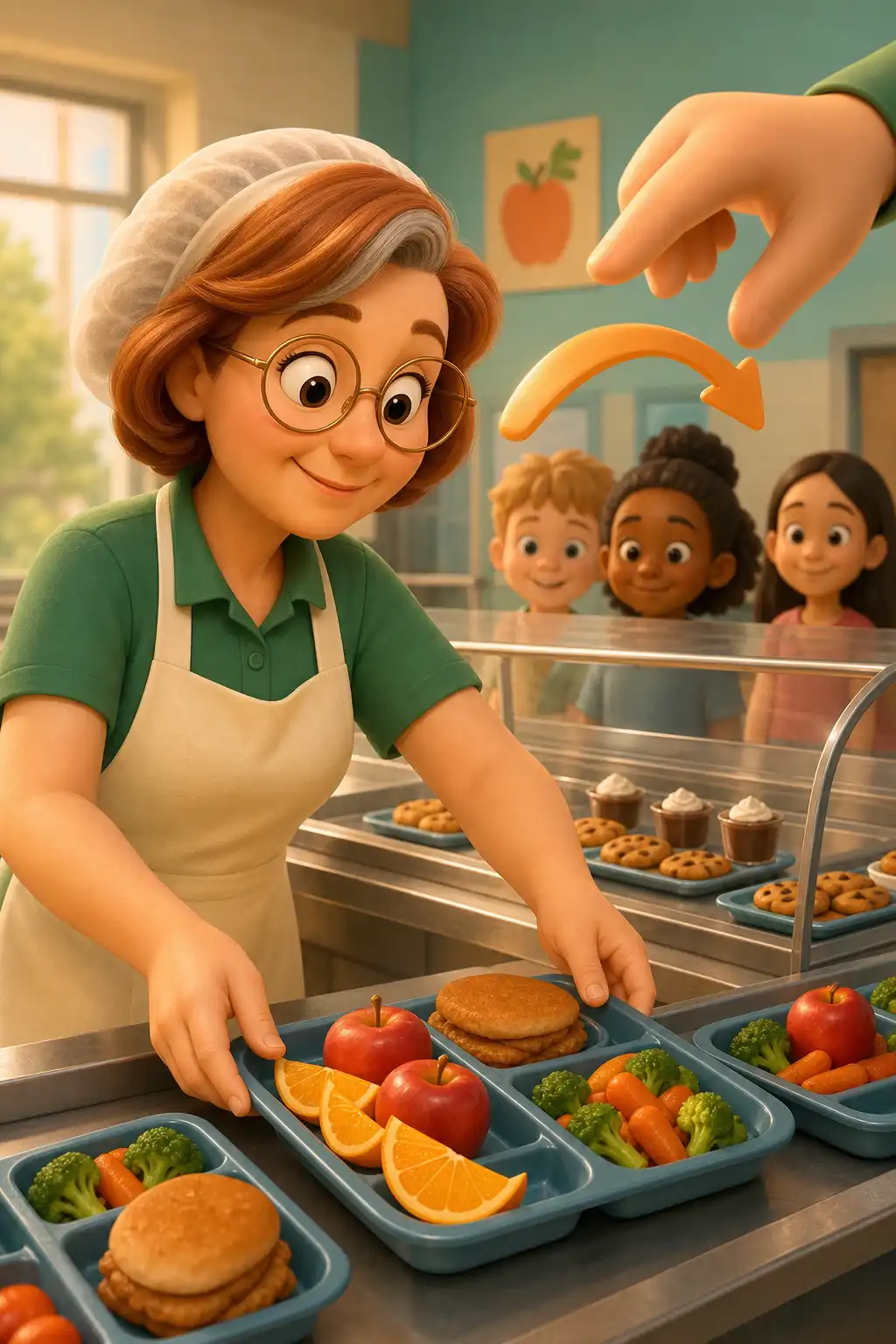
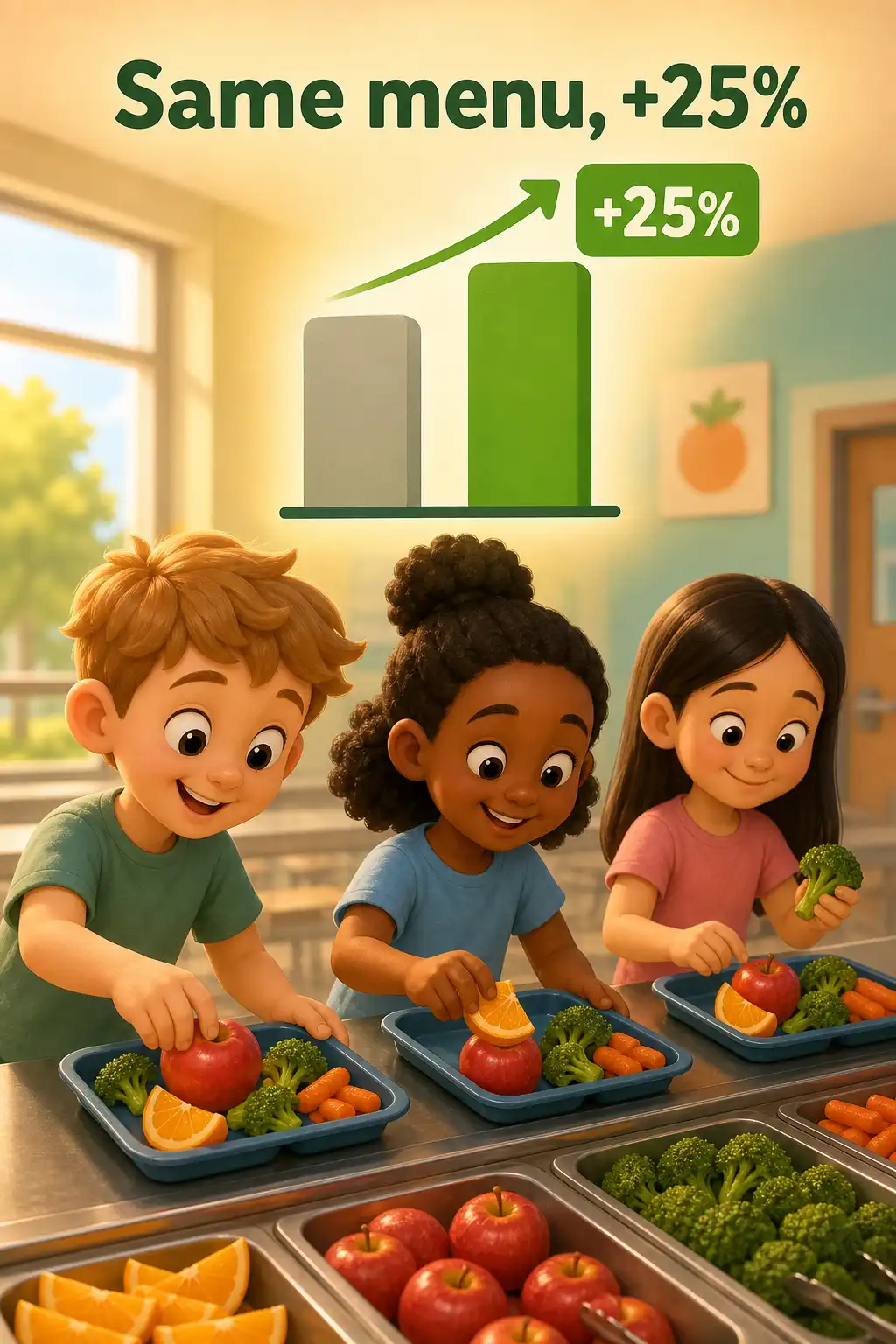
Picture Carolyn, a school cafeteria director who discovers something wild. Just by rearranging the food, changing nothing on the menu, she shifts what kids eat by up to twenty-five percent. Same options, new display, and the lunch trays sway.
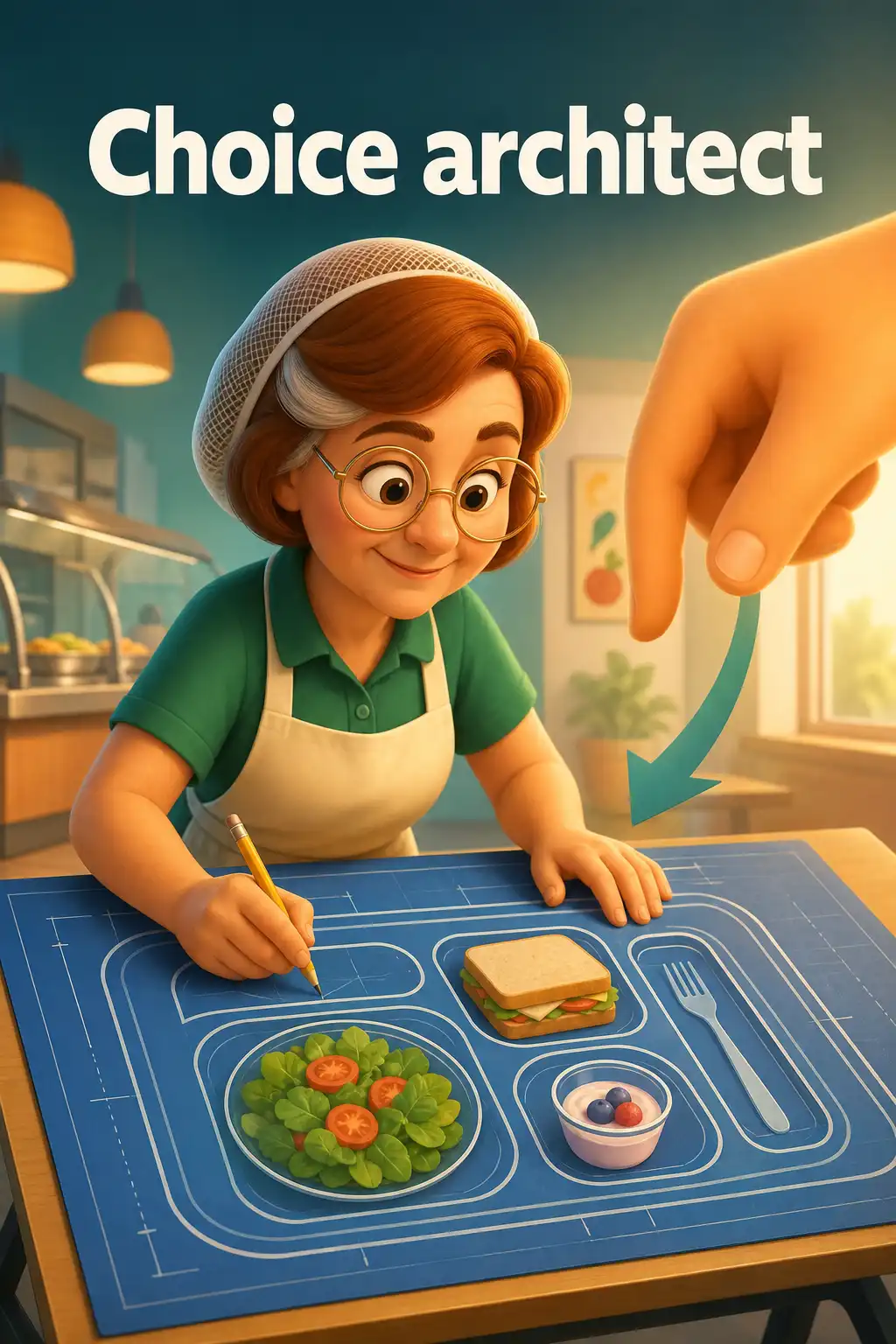
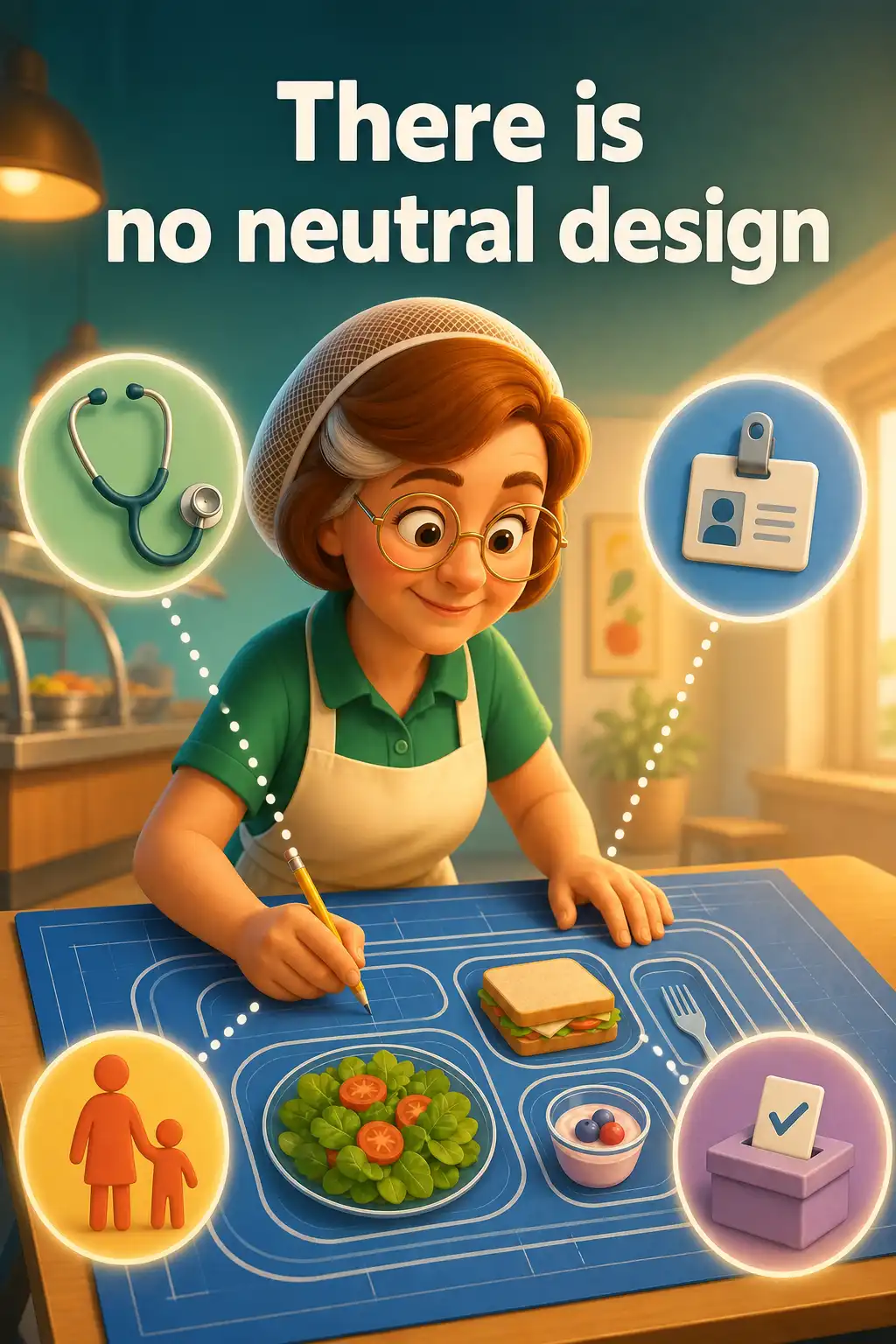
Thaler and Sunstein call her a choice architect, anyone who designs the context where decisions happen. Doctors, employers, parents, ballot designers. And there's no neutral way to arrange the tray, because the food has to sit somewhere either way.
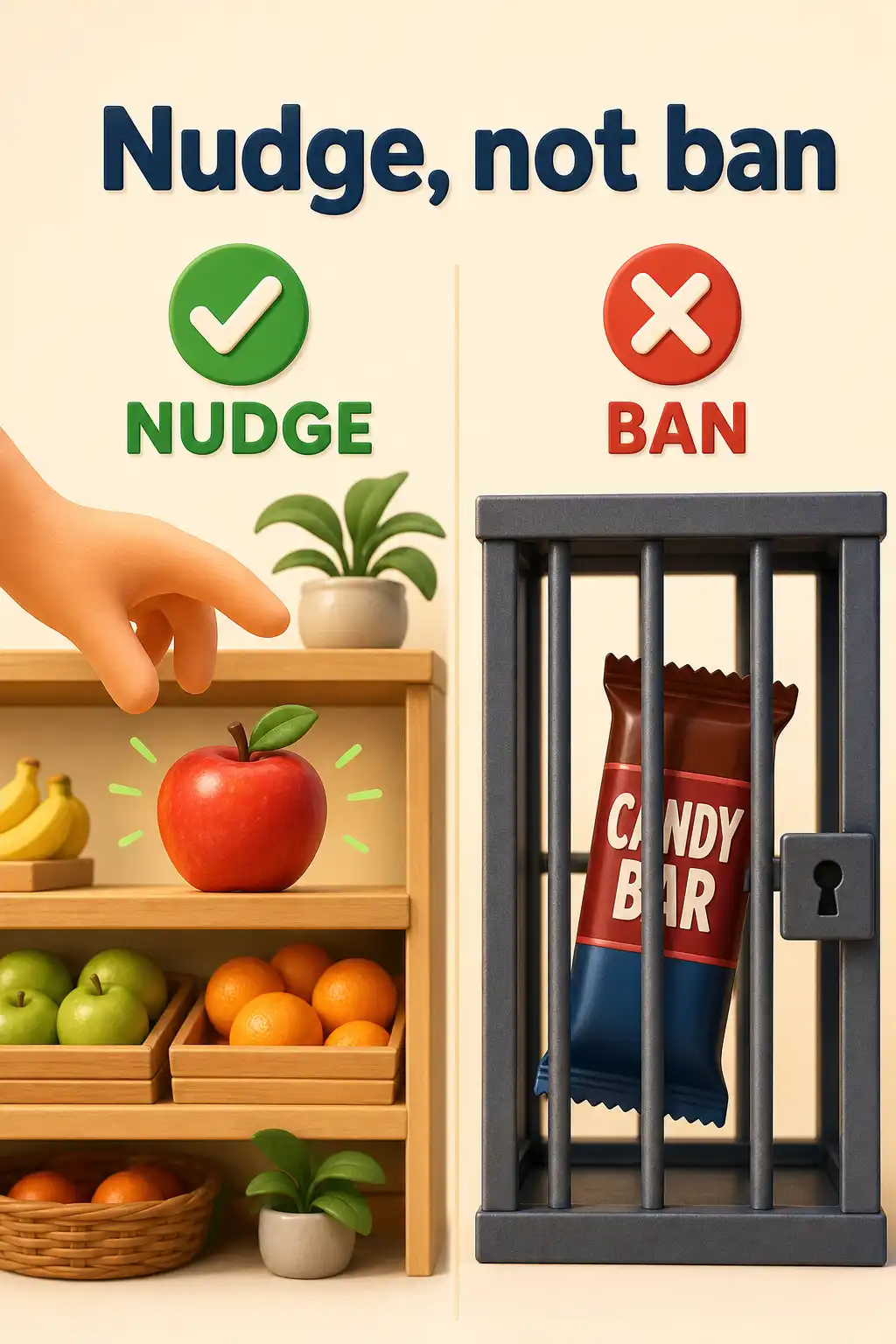
A nudge changes behavior predictably without banning options or raising costs. Fruit at eye level is a nudge. Banning junk food is not. This is libertarian paternalism, gentle steering with every exit unlocked and freedom fully stocked.
Why bother? Because textbook economics imagines flawless 'Econs,' while real humans run on inertia and overconfidence. Whatever option comes pre-selected tends to win, so defaults keep winning elections nobody knew they'd elected.
Meet Tina, an HR manager in Tampa. Her problems, almost nobody joins the 401(k), open enrollment is chaos, the breakroom is a donut buffet, and her credit card balance sings the same sad song all year long.
Tina's been blasting reminder emails for years, and nothing changes. As we follow her through these lessons, she'll discover she was a choice architect all along, and once she designs on purpose, results come on strong.
Next step
Watch Nudge instead
Quick setup, then watch this summary in a more engaging visual format.
iOS + Android app20,000+ learnersFree daily summary
2. Your brain takes shortcuts that misfire predictably
Psychologist Roger Shepard once drew two tables that look wildly different, yet their tops measure identical. People aren't just wrong about it, they're confidently wrong, because context pulls perception along. That's not stupidity, that's simply how minds run.
Your brain runs on two systems. The Automatic System is fast and instinctive, ducking a ball without thought. The Reflective System is slow and deliberate, grinding through math like it ought. Errors happen when the fast one answers questions the slow one should've caught.
Then come the shortcuts. Anchoring, where you estimate from whatever number is nearby, even random digits, and barely adjust, which charities exploit with high suggested donations. Availability, where plane crashes feel scarier than strokes because they're vivid, so fear outvotes statistics in conversations.
Add unrealistic optimism, where most people rate themselves above-average drivers, plus loss aversion, where losing stings about twice as hard as an equal gain feels nice. The result is status quo bias, clinging to what you have without checking the price.
Framing finishes the job. 'Ninety of a hundred patients survive' comforts, 'ten die' alarms, yet both are the same claim. Chicago painted narrowing stripes before a deadly curve so drivers feel speed and brake by reflex, working with the brain's frame.
Tina audits her enrollment page. Contribution suggestions anchored low, plan descriptions written like tax code, the best option buried below the fold. So she reframes it. 'You're losing free employer match every month you wait.' A few coworkers finally take the bait.
3. Outsmart your impulsive inner Doer
Thaler once removed a bowl of cashews so his dinner guests would still want dinner, and they thanked him. Economics says more options never hurt, but human preferences flip fast. What you want now betrays what you wanted last.
That's the hot-cold empathy gap. Cold-state you, the Planner, makes wise commitments. Hot-state you, the Doer, grabs the Cinnabon, because airports literally pump that aroma down the hallways. Hot-you overrules cold-you almost always.
Mindlessness compounds it. Brian Wansink's research found people eat far more from bigger containers, even when the food is stale. Plate size is a silent nudge, and willpower was never built to scale.
The fix is binding your future self. Commitment devices like Christmas savings clubs, bets with friends, and mental accounting, labeling money into separate untouchable jars. Economically irrational, behaviorally brilliant, stronger than willpower by far.
Tina starts at home. A savings account labeled 'emergency only,' auto-transferred every payday, so money moves before temptation gets a say. She even stakes fifty bucks with her sister as a penalty for skipping. Willpower optional, commitment gripping.
At work, she shrinks the breakroom donut platters and parks fruit next to the coffee machine. Nothing is banned, nobody protests, yet snacking drops all the same. Choice architecture, quietly changing the game.
4. People copy people, so steer the herd
In Solomon Asch's classic experiments, when a group confidently gave obviously wrong answers on a simple visual test, about three-quarters of participants conformed at least once. The crowd beat their own eyes, no contest.
Two forces drive it. Information, since if everyone believes it, maybe it means something, and peer pressure, since disapproval stings. Even hit songs work this way. One experiment showed that early downloads, not quality, decide what the world sings.
Norms can be steered for good. Texas cut visible highway litter by roughly seventy-two percent with sports stars and 'Don't Mess with Texas' pride. Minnesota raised tax compliance by announcing that over ninety percent of residents already paid, and honesty spread once the norm was displayed.
One caution, comparisons can boomerang. Californians told they beat the neighborhood energy average actually used more, until a smiley face made thrift feel adored. And priming works. Asking people when and where they'll act makes follow-through soar.
Tina ditches the guilt trips. Her message leads with a true norm. Most colleagues already use company benefits, and joining the 401(k) takes two minutes flat. Then she asks each person to pick a day and time to enroll. Just like that.
Sign-ups tick upward for the first time in years, not because she argued harder, but because she made saving feel normal and gave it a where and a when. The herd is a tool. Aim it well, then aim again.
5. Give the most help where choices are hard and rare
When do people need nudges most? When choices are hard, rare, and give lousy feedback. You buy bread weekly and learn fast. You pick a mortgage maybe twice in life, no practice rounds, feedback arriving years past.
Timing traps you too. Junk food pays pleasure now and bills your health later, while exercise charges now and pays later. When costs and benefits are separated by years, the Doer takes the wheel and the Planner disappears.
Don't expect markets to rescue you either. Extended warranties often sell at roughly ten times their expected value, because firms sometimes profit more from feeding your confusion than fixing it. When your mistakes are lucrative, education takes a hit.
Tina watches open enrollment melt people down. Sixty pages of deductibles and coinsurance, so employees just re-pick last year's plan on autopilot, even when their lives have changed. Status quo bias, taking its bow.
So she builds a one-page translator, converting each plan into real yearly dollars for three sample households. Suddenly it reads 'this plan costs your family eight hundred more a year,' and the fog starts to clear.
Complaints drop and better matches rise. The takeaway, when a decision is rare and complex, don't print more brochures, build better translation. The harder the choice, the more it deserves deliberate design and dedication.
6. Design with the NUDGES checklist
Ever pulled a door with a big handle that actually needed a push? Students kept pulling even after being warned. When design signals one action but requires another, humans fail on cue. Good architecture makes the right move the obvious thing to do.
Thaler and Sunstein pack the toolkit into an acronym, NUDGES. iNcentives, Understand mappings, Defaults, Give feedback, Expect error, Structure complex choices. Six levers inside every form, menu, and app, a checklist for closing the human gap.
Expect error, like the Paris Metro accepting cards in any orientation, or Gmail asking if you forgot the attachment. Give feedback, like digital cameras showing every shot. Make incentives salient, like a taxi meter. Costs you watch are costs you spot.
Structure complexity, like a paint store sorted by color family instead of alphabetically, or Netflix recommendations filtering millions of titles. And honor defaults above all, since whatever comes pre-selected is what most people will haul.
Tina rebuilds the benefits portal using the checklist. A sensible default plan, a confirmation screen catching empty fields, and an annual plain-English statement of what each person paid in premiums and fees. Errors expected, feedback delivered, complexity brought to its knees.
Her boss asks which consulting firm she hired. Nope, just six principles and one Tuesday afternoon. Design for the humans who actually show up, not imaginary Econs, and the results follow soon.
7. Automate your money before willpower fails
Now, money. In 2005, America's personal savings rate went negative for the first time since the Great Depression. Retirement math is genuinely hard, and willpower fails even the experts, by their own confession.
The heavyweight nudge is automatic enrollment. Flip the default so workers join the 401(k) unless they opt out, and participation leaps from around twenty percent to over ninety. Few ever back out, so apparently people wanted savings aplenty.
Then there's Save More Tomorrow, from Thaler and Shlomo Benartzi. You commit now to raising your savings rate with each future raise. Your paycheck never visibly shrinks, so loss aversion stays asleep. Pilot participants nearly quadrupled their savings, a promise future-you keeps.
Investing has traps too. Checking your portfolio constantly makes normal dips feel like knives, so people buy high and sell low. Overloading on company stock ties job and savings to one fate, as Enron workers learned when both evaporated on the same date.
Tina pitches leadership on automatic enrollment plus automatic escalation, both encouraged by the Pension Protection Act. Within a year, participation rockets past ninety percent and nobody complains, because good defaults don't trap people, they attract.
She nudges herself too, switching her credit card from the minimum-payment default, which quietly maximizes interest, to automatic full-balance pay. Twelve months later, that sad-song balance has finally faded away.
8. Nudge for good, out in the open
Choice architecture can save lives. In one classic study, organ donation consent roughly doubled when the default flipped from opt-in to opt-out. The authors favor mandated choice, where you state your preference at license renewal, so inertia loses its clout.
It works for the planet too. The Ambient Orb glows red during heavy energy use and helped cut peak consumption by around forty percent among users. Forcing firms to disclose toxic emissions let public pressure do the rest. Transparency cleans up the mess.
What about manipulative nudgers? The safeguard is the publicity principle. Never deploy a nudge you wouldn't defend out loud. Keep opt-outs easy, disclose conflicts, let sunlight disinfect. A good nudge survives being shown to the crowd.
And for slippery-slope worriers, neutrality was never on the table, because some default always exists as well. The question isn't whether to influence, it's whether to influence thoughtfully. Good design answers that, truth to tell.
A year in, Tina's company saves more, picks better health plans, and eats marginally fewer donuts. She never banned anything or hid a trick. Every nudge sits openly on the intranet. Freedom intact, results that stick.
That's the heart of Nudge. Tiny details shape behavior enormously, so shape them with care and keep every exit on display. You're already an architect of choices, yours and other people's. Might as well design on purpose, starting today.
Next step
Start watching in minutes
Take the short quiz and unlock animated summaries you can watch or listen to daily.
iOS + Android app20,000+ learnersFree daily summary