A detailed summary ofBreakthrough Advertisingby Eugene Schwartz
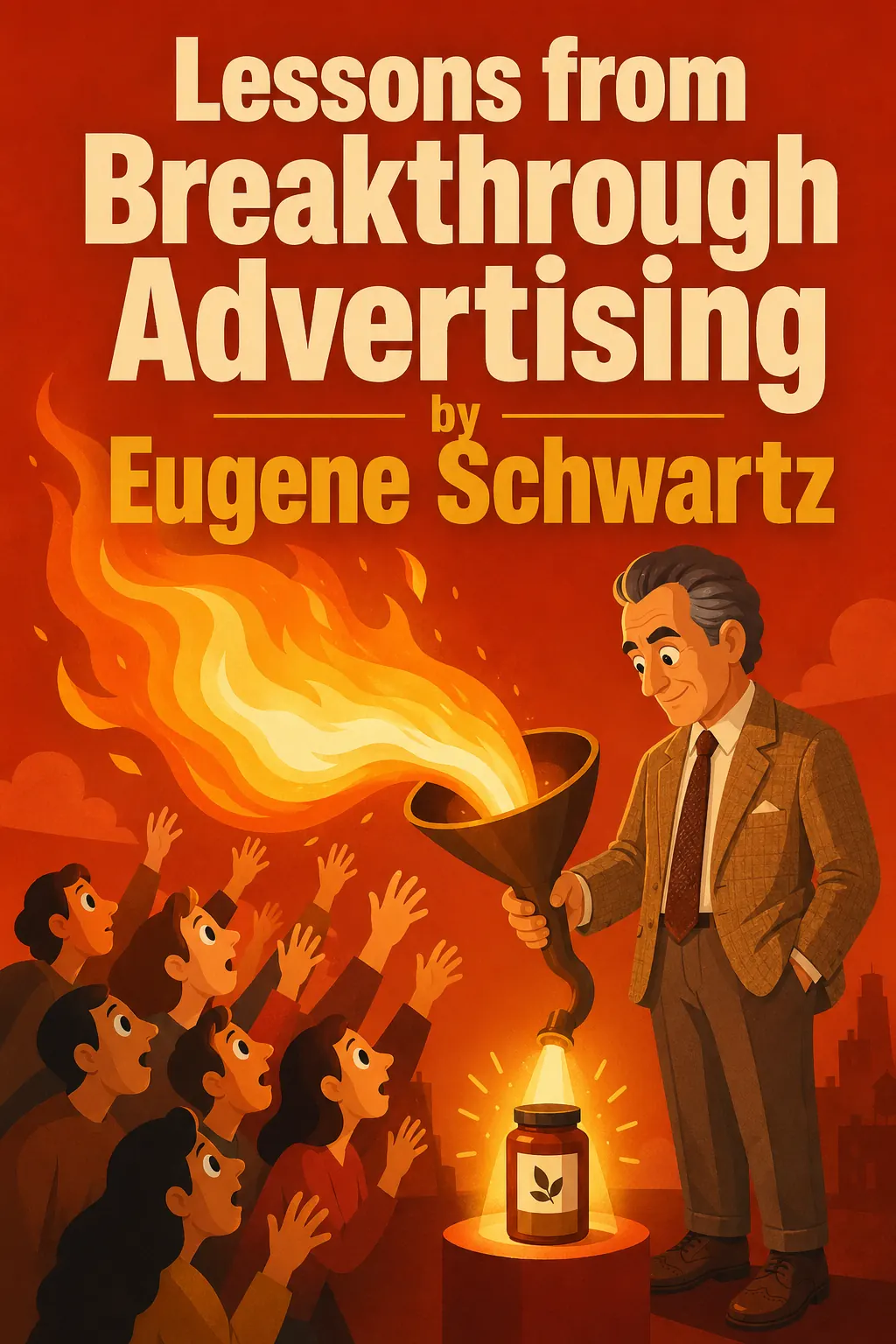
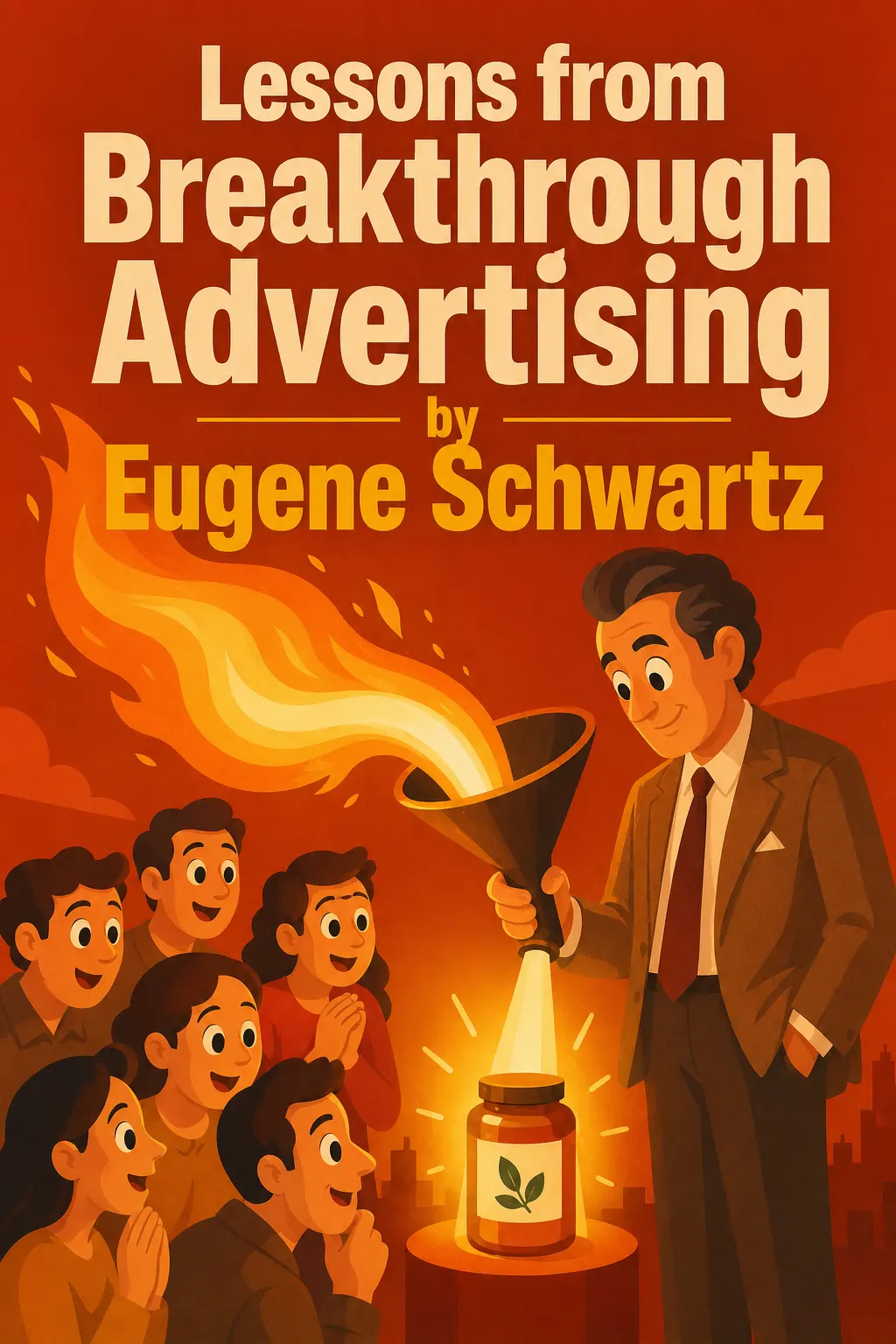
Breakthrough Advertising by Eugene Schwartz is a legendary guide to creating markets by channeling the desires already burning inside your customers. Not inventing want. Channeling it.









Picture Emma.
0:00 / 1:00
60-second animated preview
Summary Visuals
The 5 Stages of Awareness
When Claims Wear Out
Breakthrough Advertising Summary
Picture Emma. It's midnight, she's staring at her laptop, watching her handcrafted candle shop's ad spend vanish with almost no sales to show for it. She's wondering, honestly, what she's doing wrong.
1. You can't manufacture desire
Emma refreshes her dashboard one more time. Three hundred dollars spent, two candles sold. Her ad shouts, 'Discover the joy of artisan candles!' into what feels like an empty room.
Notice what she's doing. She's trying to teach strangers why they should want her candles. That's where she's stuck, and it's exactly where Eugene Schwartz starts the book.
Schwartz, a legendary mail-order copywriter who rose to fame in the 1950s and 60s, argues something almost heretical. Advertising never creates desire. It only channels desires that already exist in the reader.
He points to Ford trying to sell safety in a horsepower-crazed era. People wanted speed, not safety lectures. The ads quietly flopped, no matter how clever the copy.
Emma realizes she's lecturing too. Nobody is lying awake craving 'artisan candles.' But plenty of people crave a few minutes of calm after brutal, overstimulating workdays.
Her job, Schwartz would say, isn't inventing want. It's finding the want already burning, and then pointing it, gently but precisely, straight at her product.
Next step
Watch Breakthrough Advertising instead
Quick setup, then watch this summary in a more engaging visual format.
iOS + Android app20,000+ learnersFree daily summary
2. Meet the prospect's awareness
Next morning, Emma rewrites her headline three times and hates all three. Schwartz tells her something that flips the whole exercise on its head. The headline isn't supposed to sell anything.
Its only job, he insists, is to pull the reader into the next sentence. That's it. That single shift loosens something tight in her chest.
Schwartz describes five awareness stages, ranging from people who already know your product and want it, all the way to people who haven't even named the problem they have.
Most of Emma's audience sits somewhere in the middle. They feel frazzled, sure, but they aren't searching for candles. They're barely searching at all. They're scrolling.
So instead of 'Discover artisan candles,' she writes a new line. 'The five minutes that finally quiet your mind after a twelve-hour day.'
The headline names a feeling, not a product. It meets her reader exactly where their tired, distracted mind already is tonight, on the couch, phone in hand.
3. Watching market sophistication
Emma scrolls Instagram and groans out loud. Every candle brand promises calm, focus, cozy vibes. Her fresh angle suddenly feels like everyone else's tired angle.
Schwartz would just nod. Markets, he says, move through stages of sophistication. First, simple claims work. Then bigger, louder claims work. Then claims stop working entirely.
He traces this through cigarette ads, going from simple pleasure promises in the 1930s, to elaborate filter mechanisms in the 50s, to pure identity campaigns like the Marlboro cowboy.
When everyone is shouting the same promise, you stop competing on the promise itself. You compete on a new mechanism, a fresh how-it-works that nobody else can claim.
Emma's candles use a slow-burning coconut wax blend infused with bergamot harvested in Calabria, one specific region in southern Italy. She had been hiding all of that in tiny fine print at the bottom of her product page.
Now she pulls the mechanism right into her headline, giving tired readers a believable reason her calm actually feels different from everyone else's calm.
4. Verbalizing the claim
Her new headline still feels flat. Schwartz offers thirty-eight ways to verbalize a claim, sharpening the same idea through measurement, metaphor, sensory detail, or even paradox.
Emma tries measurement first. Her candles burn for sixty hours. The bergamot is hand-picked across forty-two acres along the Ionian coast of Calabria, in southern Italy.
Then she tries sensory language, describing the small moment when the wick catches and the room slowly fills with warm citrus, soft cedar, and something like quiet.
She tests a question headline. 'What if the last five minutes of your day actually felt like yours again?' That one stops her cold. It feels honest.
Schwartz warns against echoing other people's winning ads or relying on tired formulas. Real headlines come from analyzing this specific product, for this specific reader, in this specific moment.
Emma saves her question version. It came from her actual customer's nightly ritual, not from someone else's swipe file pinned on Pinterest.
5. Intensifying desire in the body
Her new headline pulls people in. But then they bounce off the product page. The body copy reads like a polite museum placard about wax composition.
Schwartz calls the body copy's job intensification. You take that vague flicker of interest the headline created, and you fill it with vivid, concrete pictures of life with the product.
He suggests dropping the reader inside the scene. So Emma rewrites it. 'You strike the match. Bergamot rises. Your shoulders drop almost immediately, before you even notice.'
She stretches the benefit across time, walking the reader from tonight, to the third evening, to the quiet ritual two weeks from now when lighting the candle becomes muscle memory.
She adds contrast, comparing harsh synthetic candles, the kind that give her a low headache by hour two, against the slow, clean burn of her coconut-wax blend.
Same promise, told thirteen different ways. Schwartz says reinforce without repeating, and Emma finally feels desire actually building as she rereads her own page.
6. Selling identity, not objects
Sales tick up, but Emma notices something curious. Her best customers aren't buying calm. They're posting photos of her candles on tidy reading nooks and dusty windowsills.
Schwartz would say they're buying identification. The quiet feeling of being a certain kind of person. Thoughtful, intentional, slightly aspirational, a little bit literary.
Every product, he argues, should offer two reasons to buy. A functional benefit, and a role the purchase lets the buyer publicly express to the world.
He cites Marlboro pulling rugged masculinity out of the cowboy archetype, and a piston ring ad framed inside a gleaming sports car driven by a quiet, understated success.
Emma reshoots her photos. The candle now sits beside a worn novel, a steeping cup of tea, and a half-finished journal page with a pen resting across it.
She isn't faking an identity here. She's reflecting the one her customers already aspire to, and gently letting her candle become its quiet symbol.
7. Building belief gradually
A skeptical comment appears under one of her ads. 'Forty dollars for a candle? Really?' Emma winces. Schwartz tells her to never argue with belief head-on.
Instead, he teaches gradualization. You lead the reader through small agreements first, building a habit of saying yes inside their own head, before any big claim arrives.
He shows a TV repair manual ad that opens not with savings or cleverness, but with a suspicion readers already quietly hold. The feeling of being kept in the dark by repair shops.
Emma rewrites her product page. It opens with, 'Most candles are made to be cheap, not to be lived with.' Her readers nod before they realize they're nodding.
Then she walks them through how mass-produced wax burns, why the headaches happen, and why slow-poured coconut wax behaves completely differently in a quiet room.
By the time the price appears, the reader has already agreed to a dozen small truths. Forty dollars suddenly feels almost obvious. Maybe even fair.
8. Redefining the drawback
Still, some readers complain her candles take longer to ship, because each batch is poured to order. Emma had worried this delay would scare buyers off for good.
Schwartz calls his fix redefinition. He points to Lifebuoy soap, whose strong medicinal smell got reframed as actual proof that it was killing odor-causing bacteria, rather than a flaw to apologize for.
A liability, used correctly, becomes the most convincing asset you have. Schwartz nicknames it concept-judo, flipping the prospect's objection into your strongest selling point.
So Emma stops apologizing for the wait. Her new copy explains that each candle is poured the week you order it, never sitting on a warehouse shelf for months losing its scent.
Suddenly, the delay isn't a flaw at all. It's the entire reason the scent feels alive instead of stale. A small ritual customers actually start to anticipate.
9. Camouflage and final touches
Emma's last problem is that her ads still scream 'ad.' Schwartz introduces camouflage, the idea of borrowing trust from the surroundings a reader already trusts.
He shows a financial ad redesigned to look like a Wall Street Journal editorial. Same words, new format. It ran nineteen times without losing its pulling power.
Emma reformats her newsletter to feel like a quiet evening essay, not a sale pitch. Honest, plainly written, even openly admitting that her candles aren't for everyone.
Schwartz finishes the book on placement, rhythm, and mood, reminding writers that proof lands hardest when the reader is silently asking for it, not when you're shoving it at them.
A year in, Emma's shop is profitable. She didn't invent desire. She found it, named it, and gently led people toward her small, steady flame.
Next step
Start watching in minutes
Take the short quiz and unlock animated summaries you can watch or listen to daily.
iOS + Android app20,000+ learnersFree daily summary
More books like Breakthrough Advertising

Sell Like Crazy
by Sabri Suby
Sell Like Crazy by marketing entrepreneur Sabri Suby is a step-by-step playbook for attracting a flood of dream customers and turning any business into a predictable selling machine.
Influence
by Robert Cialdini
"Influence" by Robert Cialdini reveals the seven powerful principles of persuasion that shape nearly every "yes" we give, often without us realizing it.

Launch
by Jeff Walker
Launch by Jeff Walker teaches a step-by-step formula for turning your product release into an event, building anticipation and trust so that customers are genuinely excited to buy before you even ask.

Building A StoryBrand
by Donald Miller
Building A StoryBrand by Donald Miller shows how to clarify your message so customers actually understand what you offer and feel pulled to buy it.
The 48 Laws of Power
by Robert Greene
The 48 Laws of Power by Robert Greene distills three thousand years of history into blunt, practical laws for gaining power, defending yourself, and understanding how people really operate.

The Laws of Human Nature
by Robert Greene
The Laws of Human Nature by Robert Greene decodes the hidden forces driving human behavior, teaching you how to read people accurately and master your own self-destructive impulses.
Related book lists
7 summaries
Marketing
Acquire and retain customers with standout storytelling.
4 summaries
Copywriting
Craft persuasive words that sell ideas, products, and stories.
33 summaries
Psychology
Understand how people think, feel, decide, and behave.



8 summaries
Sales
Close more deals and build repeatable playbooks.
9 summaries
Influence
Shape opinions, build authority, and move people to action.